

If you’ve been wondering whether your child might benefit from seeing a speech pathologist, you may also be wondering what an assessment actually looks like.
Will my child be tested?
What if they don’t talk?
Will I stay with them?
What if they’re shy, tired or simply don’t feel like cooperating that day?
These are completely reasonable questions.
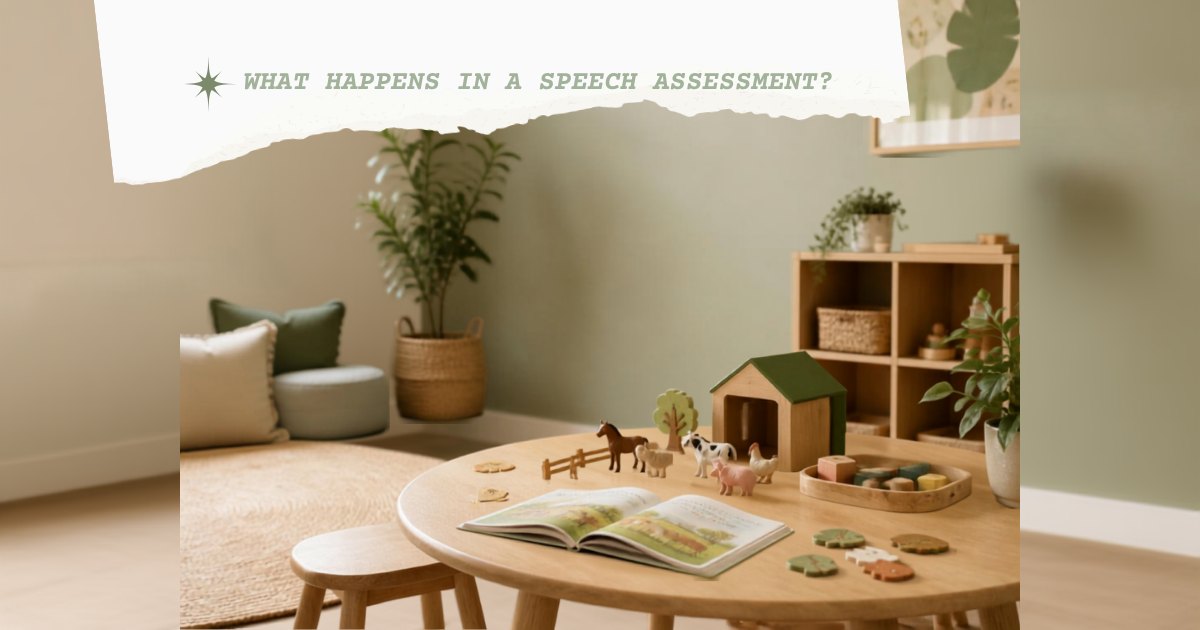
For many children, a speech and language assessment looks much less like a formal test than parents might imagine. Depending on your child’s age and what we’re exploring, there may be toys, books, pictures, conversation and play alongside more structured assessment activities.
Most importantly, a child can’t fail a speech and language assessment. It isn’t that kind of test.
The purpose is to understand how your child communicates, where their strengths lie and whether there are areas where some additional support may be helpful.
Here’s what the process can involve.
Before your child’s speech assessment
You don’t need to know exactly what type of assessment your child needs before getting in touch.
You also don’t need a referral to enquire about speech pathology at Capability Psychology & Wellness.
Before or during the initial stages of the assessment process, we’ll want to understand what you’ve noticed and what you’d like some help understanding.
Perhaps your child isn’t using as many words as you expected. Maybe they’re talking plenty, but people outside the family have difficulty understanding them. They might find following instructions challenging, become frustrated when they can’t communicate what they want, or have difficulty telling you about something that happened. If you’re not sure what’s typical for your child’s age, our guide to speech and language milestones may help.
If your child has previous reports or relevant information from their GP, paediatrician, childcare, kindy, school or another health professional, it can be helpful to bring these along.
If you don’t have anything, that’s okay too.
One useful thing you can do is think of a few real examples of what’s prompted your concern. Everyday examples can help your speech pathologist understand what communication looks like for your child outside the clinic.
First, we want to understand your child
Before focusing on assessment activities, your speech pathologist will want to understand the bigger picture.
That includes hearing from you.
Depending on your child and the reason for assessment, you may discuss things such as their developmental history, communication, health and hearing history, childcare or school experiences and what you’ve noticed at home.
We’ll also want to understand your child’s strengths and what communication looks like when they’re comfortable.
Most importantly, we’ll talk about what you’re hoping to understand.
That’s because not every speech and language assessment is looking for the same thing.
For one family, the question might be why their toddler isn’t using many words yet.
For another, it might be why their school aged child has difficulty following verbal instructions.
Another family may be concerned because their child knows exactly what they want to say but is frequently difficult for other people to understand.
Understanding the question helps guide the assessment.
What does the assessment look like for my child?
This depends on your child’s age, communication and what needs to be explored.
For younger children, assessment can involve play and observation.
There might be toys, books, pictures or activities that give the speech pathologist opportunities to observe how your child understands and uses communication.
It may look like play to your child, while the speech pathologist is carefully observing and gathering information.
For older children, there may be more structured activities.
They might look at pictures, answer questions, follow instructions, describe something or complete specific language or speech tasks.
Standardised assessment tools may also be used where appropriate. These are structured tools that help clinicians understand particular aspects of a child’s communication and interpret their performance using established assessment methods.
The exact combination will depend on your child and the reason for the assessment.
What is the speech pathologist assessing?
Speech pathology covers much more than pronunciation.
Depending on your child’s needs, an assessment may explore one or more areas of communication.
Understanding language
This is sometimes called receptive language.
It refers to how a child understands the language they hear.
For example, an assessment might explore how your child understands words, questions, concepts or instructions.
Using language
This is often called expressive language.
It includes how a child uses words and sentences to communicate their thoughts, needs and ideas.
Depending on their age, this might involve vocabulary, sentence structure, describing events or telling stories.
Speech sounds
Some children know exactly what they want to say but have difficulty producing certain speech sounds clearly.
A speech pathologist can explore your child’s speech sound development and the patterns in how they produce words.
Social communication
Communication is also about how we connect and interact with other people.
Depending on the reason for assessment, a speech pathologist may consider aspects of how a child participates in conversations and communicates with others.
Fluency
Speech pathologists can also assess fluency, including stuttering.
If this is an area of concern, the speech pathologist can look more closely at what’s happening and how your child experiences their communication.
Literacy and other communication related skills
For some children, speech pathology assessment may also explore skills associated with literacy and learning.
Not every child will need every area assessed.
The purpose is to explore the areas that are relevant to your child, rather than putting every child through exactly the same process.
What if my child doesn’t talk during the assessment?
This is something parents understandably worry about.
Your child might talk constantly at home and then say almost nothing when they meet someone new.
That doesn’t mean they’ve failed the assessment.
Speech pathologists work with children with different temperaments, communication styles and levels of comfort in unfamiliar environments.
The clinician can take time to help your child become comfortable and consider information from different sources rather than expecting your child to walk into an unfamiliar room and immediately communicate as they would at home.
If your child has particular sensory, communication or accessibility needs, it’s helpful to let the team know so these can be considered as part of their appointment.
Should I prepare my child?
There’s generally no need to practise speech or language activities before an assessment.
We want to understand how your child communicates naturally.
Instead, you can prepare them in simple language that suits their age.
For a younger child, that might be: “We’re going to meet someone who helps children with talking and communication. There’ll be some activities and things to play with.”
Keeping the explanation relaxed can help avoid making the appointment feel like an exam.
What about my child’s hearing?
Hearing is an important consideration when we’re trying to understand a child’s speech and language development.
Some children with hearing difficulties don’t show obvious signs that they aren’t hearing clearly.
Your speech pathologist may therefore ask about your child’s hearing history and whether they’ve experienced things such as recurring ear infections.
Depending on your child’s circumstances, a hearing assessment may be recommended as part of understanding the broader picture.
What happens after the assessment?
Gathering information is only part of the process.
The next important step is helping you understand what it means.
Your speech pathologist can discuss what they’ve observed, explain the assessment findings and talk with you about appropriate recommendations or next steps.
Depending on the assessment, you may also receive a written report.
The goal isn’t to hand you a collection of scores and send you home to interpret them.
We want you to leave with a clearer understanding of your child’s communication, including their strengths, any areas that may benefit from support and what you can do next.
Does having an assessment mean my child will need speech therapy?
No.
An assessment is about understanding what’s happening.
For some children, the assessment may identify an area where speech pathology support could be helpful.
For others, recommendations or strategies may be appropriate without ongoing therapy.
Sometimes assessment may also suggest that another area of a child’s development would be useful to explore.
The appropriate next step depends on the individual child.
What if there seems to be more than speech or language going on?
Children don’t always fit neatly into one area of development.
Sometimes parents come to a speech pathologist because of communication concerns but have also noticed differences relating to learning, attention, emotional wellbeing, sensory experiences or everyday functioning.
Capability Psychology & Wellness is a multidisciplinary practice, with speech pathology, psychology and occupational therapy within the broader team.
This doesn’t mean your child will need to see multiple practitioners.
It means that where a broader perspective would genuinely be helpful, clinicians can collaborate, with your consent, rather than looking at one part of your child’s experience in isolation.
Do I need a referral for a speech and language assessment?
No. You can contact Capability directly to enquire about speech pathology.
If your child already has a GP, paediatrician, psychologist, teacher or another professional involved in their care, relevant information from them may be useful as part of developing a broader understanding of your child.
With your consent, our clinicians can also work collaboratively with other professionals where appropriate.
Speech and language assessments in Springwood and Logan
Capability Psychology & Wellness provides speech pathology assessments from our Springwood clinic, supporting children and families from across Logan and surrounding communities.
Our approach is warm, practical and neuro-affirming.
We don’t see an assessment as a child being tested to determine what they can and can’t do.
It’s an opportunity to better understand how your child communicates, recognise their strengths and identify whether there are areas where support may make things easier for them.
Related reading
- Speech and Language Milestones: What’s Typical, and When to Get Support
- Speech Pathology or Occupational Therapy — Which Does My Child Need?
- Psychological Assessments for Children: Which Assessment Might My Child Need?
- School Readiness: What It Actually Means (and What It Doesn’t)
Wondering whether a speech assessment might help?
You don’t need to be certain before you contact us.
If you’ve noticed something about your child’s speech, language or communication and you’re wondering whether an assessment may be useful, our team can talk with you about what you’ve noticed and help you understand the next step.
Contact Capability Psychology & Wellness to enquire about a speech and language assessment at our Springwood clinic. No referral is required.
This article provides general information only and isn’t a substitute for individual medical, developmental or allied health advice.
Leave a Reply